ICRA15 WS on Under-actuated and Redundant Compliant Manipulation
To be filled
To be filled
Alberto Parmiggiani(1), Masayuki Inaba(2), Nikos Tsagarakis(3)
(1) iCub Facility - Istituto Italiano di Tecnologia (IIT)
Via Morego, 30 - 16163 Genoa, Italy
(2) JSK Robotics Laboratory - Department of Mechano-Informatics - University of Tokyo
Eng. Building No. 2 7-3-1, Hongo, Bunkyo-ku, Tokyo, Japan
(3) Advanced Robotics - Istituto Italiano di Tecnologia (IIT)
Via Morego, 30 - 16163 Genoa, Italy
Humanoid robot technology has made significant progresses in the past years. Research prototypes are now beginning to demonstrate relevant tasks and significant autonomy levels. Nevertheless to be even more helpful, robots need to improve their capability of interacting physically with humans, and with unstructured environments. This, in turn, poses new challenges in the design of safe, dependable, robust and effective robotic systems.
Because of the high overall complexity, the design of humanoids requires special attention. Indeed scaling platforms from a few degrees of freedom to many, and combining all sub-modules poses significant systems integration problems. Furthermore some humanoids are beginning to equip series elastic actuators and variable impedance actuators, thus adding further complexity. This workshop will present the challenges and potential solutions concerning humanoid robot design. We will discuss the state of the art and focus on new trends, such as compliant actuation, improved design for better maintenance, new actuation principles, and methodologies for defining and evaluating performance requirements.
More information available at: http://www.icub.org/other/humanoids2014-MDHR-workshop.html
Diego Torricelli, CSIC, Spain,
Katja Mombaur, University of Heidelberg,
Alexander Schubert, University of Heidelberg,
Jose L. Pons, CSIC, Spain,
Nikos Tsakarakis, IIT, Italy
Zhibin Li, IIT, Italy
Achieving stable, efficient and versatile locomotion is one of the main goals of humanoid robots. In this context, the need for reliable benchmarks of bipedal locomotion is becoming more and more relevant, in order to assess the robotic behavior on a quantitative basis and to compare it with the human counterpart.
Such benchmarks or performance indicators are important in order to judge when a robot motion is “human-like” which is an often stated but never strictly defined goal. They are also important in order to compare the abilities of different robots to each other or to measure progress of an individual robot due to an implementation of new control methods or an exchange or parts. Despite this importance, no consensus has been achieved yet about the set of benchmarks that should be adopted.
This workshop aims to involve the international community interested in bipedal walking in a thorough discussion about the key features of human-like locomotion, with a specific focus on the assessment methods and protocols that can be easily applied across different laboratory settings. The aim of this workshop is to really WORK together and to come up, at the end of the day, with a preliminary, but specific proposal for benchmarks for humanoid walking.
In order to achieve this objective, the organization of this workshop will deviate from the usual structure of IEEE conference workshops based on plenary talks and discussions. After several very short challenge talks, the workshop will essentially be structured in small discussion groups, in order to promote real debate and reasoning, which possibly result in a preliminary proposal of benchmarks to be proposed to the international forum. The discussion groups will be focusing on different aspects related to functional performance and human-likeness, such as stability, efficiency, dynamic similarity, passive dynamics, etc. The discussion groups will then present their results to all workshop participants.
In order to be able to be really productive, this workshop will be well prepared via the newly established benchmarking mailing list and this webpage; and abstracts corresponding to the challenge talks will already be made available to the prospective audience in advance.
We strongly encourage the participation of all those researchers interested in sharing their ideas and willing to find common solutions.
More information available at: http://orb.iwr.uni-heidelberg.de/koroibot/?page_id=492
From Active Impedance to Intrinsically Compliant and Variable Impedance Actuators: Pros, Cons and Trade-offs
Nikos Tsagarakis
Department of Advanced Robotics at the Instituto Italiano di Tecnologia
nikos.tsagarakis (at) iit.it
Luis Sentis
Department of Mechanical Engineering at The University of Texas at Austin
lsentis (at) austin.utexas.edu
Bram Vanderborght
Vrije Universiteit Brussel
Bram.vanderborght (at) vub.ac.be
This IROS 2014 workshop has two goals. The first goal is to bring together researchers working on the development and control of actuation systems and to present a complete overview of their recent activities.
In particular we welcome contributions that demonstrate the performance of new robotic machines based on actuation principles, implementations and control techniques which span from mature active impedance drives to hybrid active and intrinsic compliant units and intrinsically variable impedance principles. The second goal is to foster collaboration among researchers that are working on different actuation principles to advance the state of the art in robotics actuation. In addition, the workshop will serve as a venue to start the preparation of a special issue for a prestigious journal. To conclude, with this workshop we aim at:
- Demonstrating the recent developments in robotic actuation, giving the opportunity of presenting and discussing recent results in this hot research area for robotics. - Advancing the state of the art in robotics actuation by fostering collaboration among researchers working on different areas of robotics actuation as e.g. actuation design, torque control joints and active impedance regulation, intrinsically elastic joints and variable impedance actuators. We envision organizing a full day workshop which will consist of a mixture of presentations divided into several topics including design of actuation systems, control of actuators and applications. The scientific and technological topics of the workshop can be summarized as follows:
1. Torque controlled joints and torque sensing technique
2. Active and passive impedance regulation
3. Novel series elastic actuator topologies
4. Parallel elastic actuation springs
5. Switchable springs and variable recruitment actuation
6. High power density joints with active cooling
7. Efficient control of hydraulic actuation
8. Efficient compliant actuation principles
9. Variable stiffness and damping joints
10. Dual actuation systems
11. Variable transmission systems
12. Electrical motor technology advancements
13. Direct drive actuation
CONFIRMED SPEAKERS:
CALL FOR ABSTRACTS:
We want to focus on high quality presentations and interactions, therefore we do not request to submit a full length paper. If you are interested to actively participate please send us (
MORE INFOS at http://mech.vub.ac.be/IROSWSActuators/Index.htm
2nd WALK-MAN project meeting in Pisa
The 2nd meeting of the project was hosted at the Università di Pisa on the 17th and 18thof February.
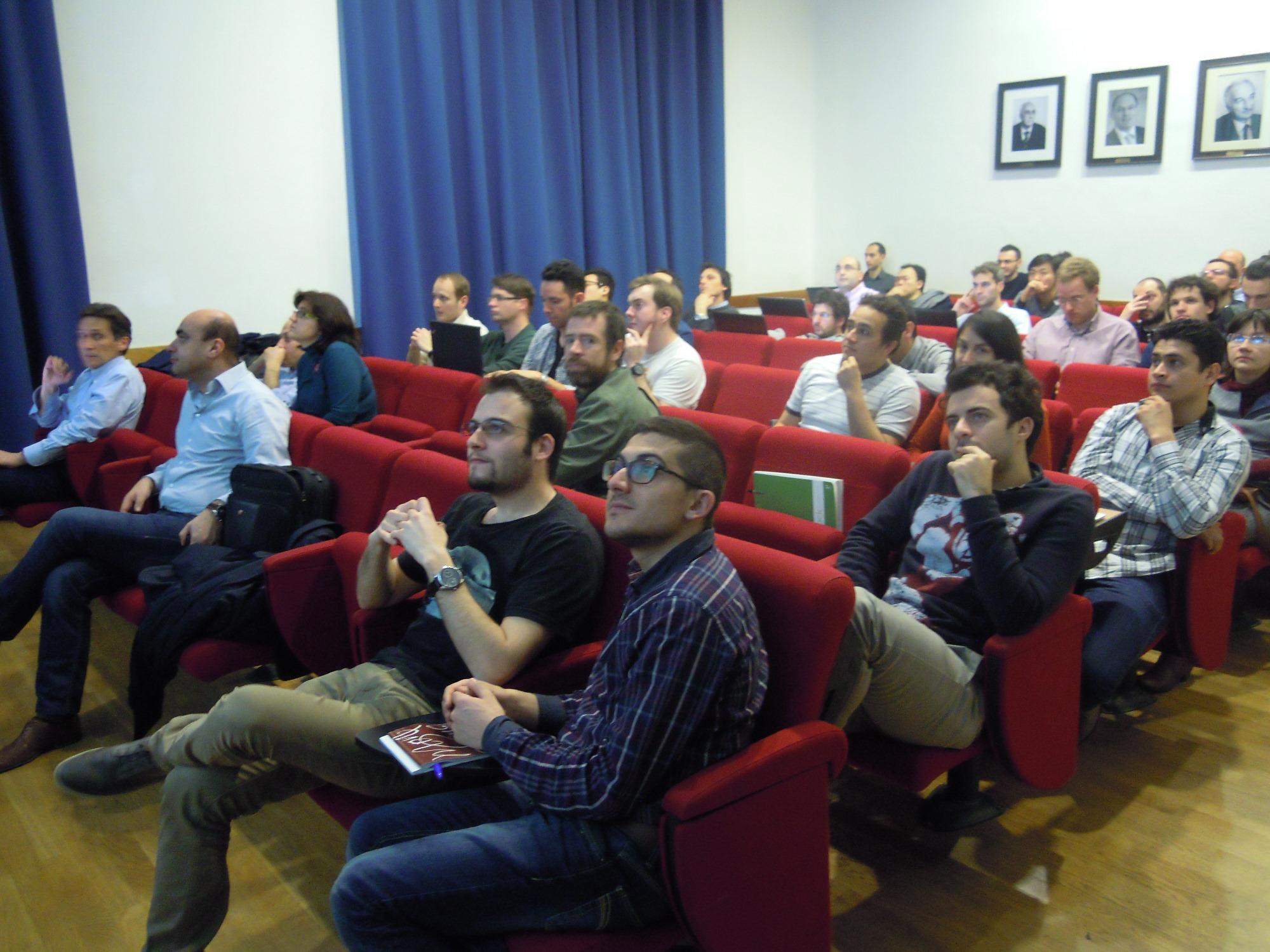
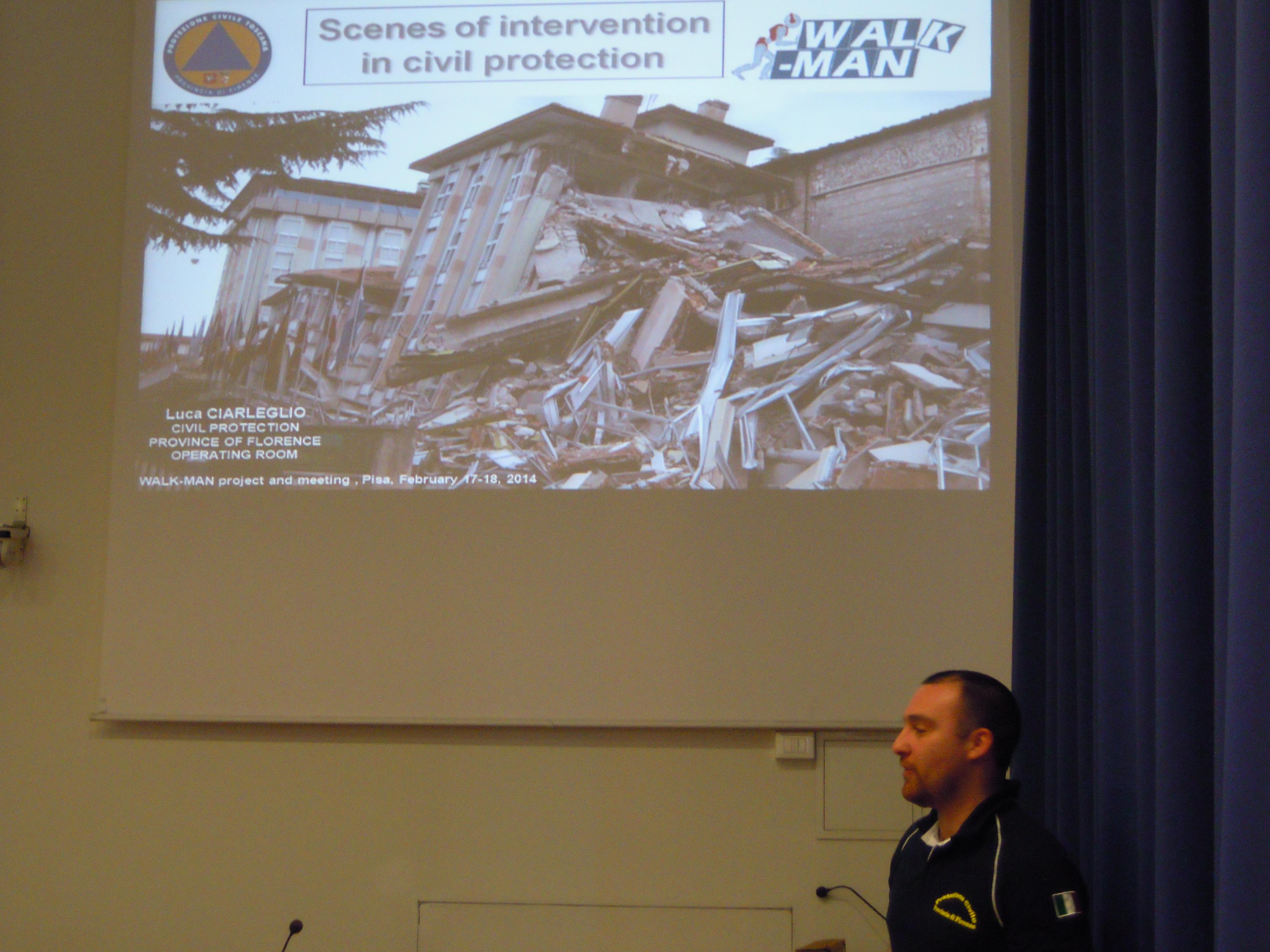
WALK-MAN was officially launched at Istituto Italiano di Tecnologia
The kick-off meeting of the project was hosted at the Istituto Italiano di Tecnologia on the 30th of September and 1st of October.
Abstract:
Manipulation and whole-body motion control are two of the most active research areas in the robotic community. Interestingly enough, there are structural similari- ties between the mathematical models of a robotic hand manipulating an object and a humanoid robot in contact with the environment. For instance, both systems are redun- dant, underactuated, and constrained by the interaction with the environment. Despite these similarities, manipulation and whole-body control have developed along different directions by two hardly connected communities. The relevant differences arise in the modelling of the contacts (e.g. soft-finger contacts vs. rigid contacts), in the adopted stability criteria (e.g. force closure vs. zero moment point conditions), and in the sim- plified models used for control design (e.g. quasi-static manipulation vs. linear inverted pendulum model).
The goal of the present workshop is to invite experts in manipulation and whole-body control to discuss similarities and differences in their respective research areas. Speakers will be invited to discuss the possibility of developing a unique framework that allows both manipulation and whole-body motion control.
Topics:
Related IEEE technical committees: